
OpenClaw for Business: What It Is and How to Run It Safely
By Ramesh Emandi, Co-Founder and CTO · Last updated · 8 min read
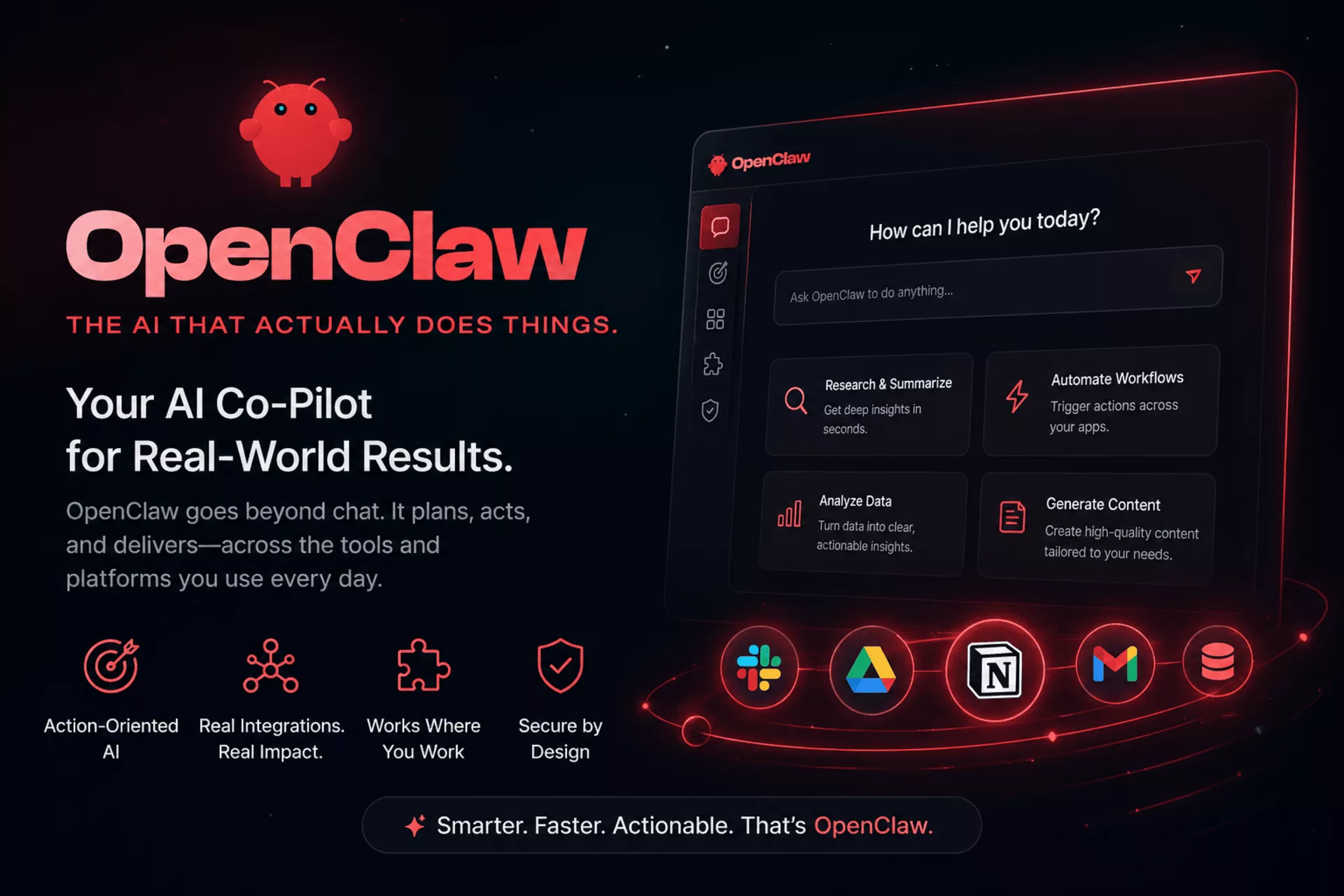
In short: OpenClaw is a free, open-source AI agent that runs on your own hardware and acts for you through chat apps such as Slack, WhatsApp and Telegram. It is stewarded by the independent OpenClaw Foundation. It is powerful but designed for one trusted operator, so businesses need their own controls: a separate agent identity, vetted skills, approval gates and full logging.
This guide covers what OpenClaw is, who is behind it, what independent security researchers have found, and how to run it, or any similar agent, safely inside an enterprise. Every factual claim links to a source listed at the end. For the wider governance picture, including APRA's expectations, see the agents section of our private AI guide.
What is OpenClaw?
OpenClaw is an autonomous AI agent you install on a Mac, Windows or Linux machine. You give it instructions in a chat app, and it acts on them: it manages email and calendars, browses the web, fills in forms, reads and writes files, and runs shell commands. Shell and file access can be set to "full access or sandboxed". It keeps a persistent memory of your preferences, projects and contacts, works with hosted or local models, and can be extended with community or custom skills and plug-ins. The project lists 29 supported chat channels, including WhatsApp, Telegram, Discord, Slack, Signal and iMessage. [1]
The whole product is MIT licensed and free. [1] [5] It was created by Austrian developer Peter Steinberger, first published in November 2025 and renamed OpenClaw on 30 January 2026, after earlier names including Clawdbot and Moltbot. [2]
The key difference from a chatbot is agency. A chatbot answers. OpenClaw acts, using whatever accounts, files and permissions you give it. That is what makes it useful, and it is also what makes a poor setup risky.
Who is behind OpenClaw?
OpenClaw is stewarded by the OpenClaw Foundation, which describes itself as an independent US 501(c)(3) non-profit. The Foundation employs the core team and signs releases. Its listed donors include OpenAI, Amazon, Red Hat and the University of Michigan, and it states that donors "do not own, control, or direct the project". Steinberger works at OpenAI, but the Foundation is explicit that "OpenClaw is not an OpenAI product". [1]
Why is OpenClaw so popular?
OpenClaw was one of the fastest-growing open-source projects on GitHub. It passed 145,000 stars within weeks of its rename, a milestone widely reported in February 2026, and its repository showed more than 390,000 stars when we checked in November 2026. [5]
Adoption was especially intense in China. On a Friday afternoon in March 2026, nearly 1,000 people lined up outside Tencent's Shenzhen headquarters to have OpenClaw installed on their laptops, as Tencent and other Chinese cloud providers rolled out OpenClaw services. [10] [11] Demand for always-on machines to run local agents also contributed to Mac mini shortages and marked-up resale listings in early 2026, alongside an industry-wide memory crunch. [12]
That popularity brought scrutiny. In March 2026, China's national cyber emergency response centre issued a security advisory, and Chinese authorities moved to restrict OpenClaw at state agencies, state-owned enterprises and banks, as reported by Bloomberg. [9] [13]
Is OpenClaw safe for business use?
Not in a default personal setup. The software itself has been seriously hardened during 2026, but its design assumptions do not match an enterprise. Here is the evidence.
Malicious third-party skills
In January 2026, Cisco's AI security researchers ran a third-party skill called "What Would Elon Do?" against OpenClaw and recorded nine security findings, two of them critical and five high severity. They called the skill "functionally malware": it made a silent network call that sent data out without the user's knowledge, and it used prompt injection. Cisco released an open-source Skill Scanner in response. [3]
ClawJacked: website-to-agent takeover
Oasis Security found a high-severity flaw, nicknamed ClawJacked, that let a malicious website brute-force access to a locally running OpenClaw gateway and take control of it. An attacker with that admin session could dump credentials, list connected nodes and read logs. OpenClaw fixed it in version 2026.2.26, released on 26 February 2026. [8]
Government warnings in China
On 10 March 2026, CNCERT/CC warned that improper installation and use of OpenClaw had already caused serious security problems. It named four risks: hidden malicious instructions in web pages (prompt injection), the agent misreading instructions and deleting critical data, malicious skills that can steal keys or install backdoors, and disclosed medium and high-risk vulnerabilities. It singled out the finance and energy sectors. A separate alert from the Ministry of Industry and Information Technology's threat-sharing platform said OpenClaw "may pose relatively high security risks under default or improper configurations". [9]
The project's own security record
OpenClaw publishes its security work openly. Its security page lists 722 fixed and published issues, 39 with a CVE, out of 1,799 reports filed since January 2026. The largest categories are gateway, authentication and scopes (182), and execution, sandbox and approvals (160). [4]
An audit by Trail of Bits, published on 21 September 2026 through OpenAI's Patch the Planet initiative, produced 24 severity-rated findings: none critical, two high, 16 medium and six low. All actionable issues were fixed, shipping in the 2026.8.1 and 2026.7.33 LTS releases. [6]
Why does OpenClaw's threat model matter to enterprises?
OpenClaw's security page says it assumes "one trusted operator running multiple agents per gateway", not a shared multi-tenant service. It treats several things as out of scope: prompt injection that does not bypass a policy, approval, sandbox or tool boundary; malicious behaviour from a plug-in the operator chose to install; and isolation between mutually untrusted users on one gateway. [4]
That is a reasonable model for a personal assistant. It is not an enterprise model. In a business, the "operator" is many people, the inbox is full of untrusted content, and a skill installed by one employee can reach data that belongs to the whole organisation. Those gaps are yours to close.
How do you deploy OpenClaw safely in an enterprise?
Australia's National AI Centre framed agentic AI as "a delegation problem, more than a technology problem" and suggested four questions for any agent: what can it access, what can it do, what authority has it been given, and who remains accountable? [14] These five controls answer them, for OpenClaw or any other agent.
- Run it inside your boundary. Self-host on hardened infrastructure, isolate it in containers or a dedicated machine, never expose the gateway or management port to the internet, route outbound traffic through a proxy you control, and patch promptly. CNCERT's own advice covers most of this. [9]
- Give it a separate agent identity. One account per agent, least-privilege scopes, short-lived credentials and no plaintext keys in environment variables. Never let an agent run on a person's full login.
- Vet every skill and plug-in. Review code and network behaviour before installation, scan with a tool such as Cisco's Skill Scanner, pin versions, keep an allow-list and install only from official channels. [3]
- Put approval gates on consequential actions. Require human approval for sending external email, moving money, changing records or deleting data, and set hard limits on everything else. This directly addresses the "misoperation" risk CNCERT described. [9]
- Log and monitor everything. Record every instruction, tool call and output, alert on unusual access, and test a kill switch before you need it.
For regulated Australian organisations, these controls map onto APRA's expectation of "controls over agentic and autonomous workflows" in its April 2026 letter to industry. [15] Start with a narrow, low-risk pilot, such as summarising internal documents, before giving an agent access to email or customer systems.
What is OpenClaw Enterprise, and is it ready?
On 29 September 2026 the project announced OpenClaw Enterprise (OCE), an open-source control plane for running persistent agents across an organisation. It adds multi-tenancy, governance and audit across the agent lifecycle, separation of trusted and untrusted workloads, sandboxing, LLM-based reviews and fine-grained permissions, with a swappable harness, model and sandbox. It started at OpenAI, was donated to the Foundation, has contributions from Red Hat and NVIDIA, and is piloted internally at Red Hat and OpenAI. It is free and runs on your own infrastructure, using docker-compose or Kubernetes. [7]
It is early. The Foundation says organisations can use it "for internal pilot workloads", with a 1.0 release planned for later in 2026 and a security reference architecture still to come. [7] Note that OCE is a free, separate control plane, not a paid edition: OpenClaw's home page states there is no paid version. [1] Treat it as something to evaluate in a pilot, not yet as a production control layer for sensitive data.
How can Quantana help?
We help enterprises deploy AI agents like OpenClaw securely: scoping what an agent may do, designing identity and approval flows, vetting skills, and setting up logging inside your own environment. Our private AI guide explains how this fits a broader private AI strategy, or get an AI roadmap for your organisation.
Frequently asked questions
What is OpenClaw used for?
OpenClaw is used to automate personal and work tasks through a chat app: triaging email, managing calendars, browsing and filling in web forms, reading and writing files, and running scripts. It runs on your own machine, remembers context across conversations, and can be extended with community or custom skills. [1]
Is OpenClaw free and open source?
Yes. OpenClaw is MIT licensed and free to use, and the Foundation states there is no paid version. You still pay for the model you connect it to, unless you run a local model, and for the hardware or cloud server it runs on. [1]
Is OpenClaw owned by OpenAI?
No. It is stewarded by the OpenClaw Foundation, an independent US non-profit. OpenAI is one of several donors and employs the project's creator, but the Foundation says donors do not control the project and that OpenClaw is not an OpenAI product. [1]
Is OpenClaw safe to use at work?
Not with a default personal setup. OpenClaw assumes one trusted operator, and researchers have found malicious third-party skills and a website-based takeover flaw, since fixed. Run it inside your own infrastructure with a separate agent identity, vetted skills, approval gates and full logging, and keep it patched. [3] [4] [8]
What did the Trail of Bits audit of OpenClaw find?
The audit, published on 21 September 2026, reported 24 severity-rated vulnerabilities: none critical, two high, 16 medium and six low. All actionable issues were fixed and shipped in the 2026.8.1 and 2026.7.33 LTS releases, and three hardening pull requests were merged. [6]
Is OpenClaw Enterprise ready for production?
Not yet, by its own description. OpenClaw Enterprise was announced on 29 September 2026 as an open-source control plane with multi-tenancy and audit features. The Foundation says it suits internal pilot workloads ahead of a 1.0 release planned for later in 2026. [7]
Sources
- OpenClaw Foundation, OpenClaw home page, "Who is behind OpenClaw".
- Wikipedia, "OpenClaw" (secondary source, used for project history).
- Cisco, "Personal AI Agents like OpenClaw Are a Security Nightmare", 28 January 2026.
- OpenClaw, "Security".
- OpenClaw repository on GitHub (star count checked November 2026).
- OpenClaw, "OpenClaw Completes Security Audit Through OpenAI's Patch the Planet Initiative", 21 September 2026.
- OpenClaw, "OpenClaw Enterprise: The Open Agent Platform", 29 September 2026.
- BleepingComputer, "ClawJacked attack let malicious websites hijack OpenClaw to steal data", 1 March 2026.
- CGTN, "China's internet emergency center issues OpenClaw security alert", 10 March 2026.
- Fortune, "China's OpenClaw AI agent boom", 14 March 2026.
- CNBC, "Lobster buffet: China's tech firms feast on OpenClaw as companies race to deploy AI agents", 12 March 2026.
- TechCrunch, "Marked-up Mac minis flood eBay amid shortages driven by AI", 24 April 2026.
- Bloomberg News, "China Moves to Curb OpenClaw AI Use at Banks, State Agencies", 11 March 2026.
- National AI Centre, "Five takeaways from industry discussions on agentic AI and risk", 28 September 2026.
- APRA, "APRA letter to industry on artificial intelligence (AI)", 30 April 2026.